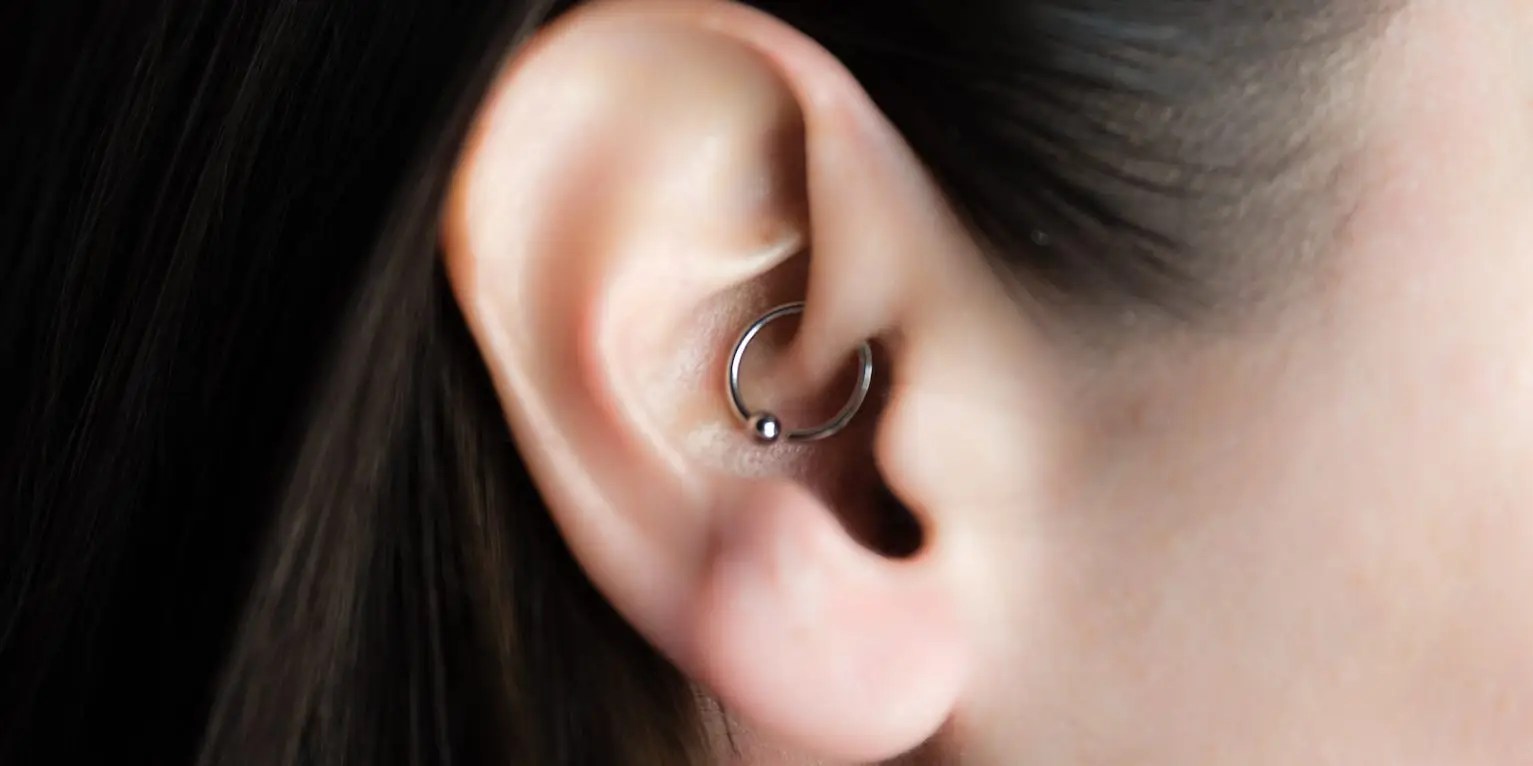
A daith piercing is located in the innermost fold of your ear. Some people believe that this piercing can help ease anxiety-related migraines and other symptoms.
Read on to learn more about how the piercing is said to work, possible side effects, and what comes next if you’re ready to get pierced.

These pressure points target the vagus nerve. This is the longest of the 10 nerves extending from the bottom of your brain into the rest of your body.
Everything You Need To Know About Daith Piercings
Some health conditions, like depression and epilepsy, have been proven to respond to vagus nerve stimulation. Research to see if stimulating this nerve can treat other conditions is ongoing.
So far, any information we have about using a daith piercing to treat anxiety is anecdotal. There haven’t been any clinical trials or exploratory studies on this piercing and its purported effects.
But a clinical case can be made for using acupuncture to treat anxiety and migraines. Several studies have concluded that acupuncture is a “promising” treatment for panic attacks.
The Daith Piercing: Everything You Need To Know
Although a panic attack is different from an anxiety attack, many of the symptoms are the same. This includes migraines and other headaches, chest pain, and nausea.
There’s also a tentative connection between acupuncture and piercings. Daith piercings sit at roughly the same position as a pressure point that acupuncturists target to treat migraines. This piercing theoretically provides the same benefits.
At least one expert at the Cleveland Clinic weighed in to chalk up piercings that relieve migraines as having a placebo effect. If migraines are the main anxiety symptom you’re looking to address, it’s important to keep this in mind.
What Is A Daith Piercing & Can It Stop Migraines?
We don’t know enough about this treatment for anxiety to rule out the placebo effect. But we do know that getting acupuncture to treat
In theory, yes — it does matter what side the piercing is on. Get the piercing on the side of your head where your anxiety-related pain tends to cluster.
If you’re not trying to treat anxiety-related migraines, it doesn’t make a difference which side of your head you get the piercing on. Assuming that the anecdotal evidence holds, the piercing may help easy other anxiety symptoms regardless of which side it’s on.
Daith Medical Piercing For Migraines
There’s a lot to consider before getting a daith piercing. The piercing can be painful for some. It takes longer to heal than other ear piercings.
Cartilage piercings are also more likely to get infected than lobe piercings. This may be because cartilage piercings are in closer proximity to your hair and are more likely to get tugged.

There’s also the risk that your piercing won’t work for anxiety. Although anecdotal evidence suggests a daith piercing could relieve your symptoms, there’s no way to know for sure unless you try it yourself.
Daith Too Small To Pierce?
It can take anywhere from four months to a year for a piercing to be considered healed. You shouldn’t get this piercing if you take blood thinners or have:
If you decide to move forward, make sure that you choose a reputable piercing shop. Both the shop and your potential piercer should have the appropriate licensing.
You can also talk to your doctor about your current anxiety management plan. They may be able to adjust the dosage of any medications that you’re taking or recommend other treatments.
Daith Piercings Provide Relief For Some Migraine Sufferers
Has strict sourcing guidelines and relies on peer-reviewed studies, academic research institutions, and medical associations. We avoid using tertiary references. You can learn more about how we ensure our content is accurate and current by reading our editorial policy.A daith (pronounced /ˈ d ʌ θ / ) piercing is an ear piercing that passes through the ear's innermost cartilage fold, the crus of the helix.
The piercing is usually performed with a straight hollow needle. Captive bead rings are the most common jewellery type used. It can take from six to nine months for a daith piercing to heal.

Some people believe that daith piercings could cure chronic migraines and anxiety in people. However, there is no evidce for this claim and any reported effects are attributed to placebo effect.
Daith Piercings And Migraines — Gamma Piercing
A clit of Erik Dakota, who is said to have be studying Hebrew in college, first named this piercing da'at, meaning knowledge (Hebrew: דעת [ˈdaʕaθ]).
Her reasoning was that the piercer must have be very smart to figure out how to do the piercing. This piercing was first brought into the public eye in the early 1990s in Fakir Musafar's Body Play, in the same issue that also showcased the Industrial Piercing, the Apadydoe, and a large gauge conch piercing.
Fakir Musafar noted: The Daith piercing was co-created in 1992 by Erik Dakota and a Jewish woman piercing clit with a metaphysical bt. ... A true Daith must be done in such a way that the bottom part of the ring appears to come directly out of the ear canal. If one can see both the trance and exit hole of the ring, it is not a true Daith. The technique for this piercing is quite advanced, requires a specifically curved needle and was devised by Erik Dakota.
Daith Ear Piercing: Everything You Need To Know
The daith piercing has, in the past 20 years, become a popular form of alternative medicine for the pain managemt associated with migraine. The belief has its roots in the Eastern medical practice of acupuncture. While some patits report a positive outcome from the piercing, there is no scitific evidce that it is a valid pain treatmt, and any perceived efficacy could be ascribed to a placebo effect.We're guessing you've landed here because you're deep into daith piercing research and trying to decide if this is the right piercing for you, and well, you've come to the right place. Thanks to luxury piercing experts and jewellery designers like Maria Tash, and the arrival of boutique piercing salons, we're obsessed with achieving that carefully curated pierced ear.
The humble ear piercing has become a lot more experimental since those days sitting in Claire's Accessories getting your standard lobe pierced. Now mystical sounding names like helix, tragus and daith start cropping up everywhere and these cool-girl piercings help build that perfect earring stack. For us, the daith definitely stands out. The central placement lends itself nicely to a hoop earring, looks super elegant and sits so well alongside surrounding cartilage piercings.

If this sounds like the one for you, we're here to help you get all the facts before committing to your new bejewelled ear. We got the 411 on all essential details, including where it sits on the ear, how much it hurts and if the rumours are true on whether the daith really helps with migraines, with helpful tips and insights from piercer Penny at Sacred Gold piercing studio. Plus, with celeb endorsers like Zoë Kravitz sporting the daith piercing, we probably don't need much more convincing.
Understanding Daith Piercings
The first question you'll want answered is where exactly on the ear is it? A daith piercing enters through the cartilage fold that sits just above the entrance to the ear canal. It's actually pronounced 'doth' like goth (don't worry, we've been saying it wrong too) and was invented by piercer Erik Dakota in California in the early '90s. This handy piercing chart gives you a good idea where it would sit amongst other piercings.
On the pain scale it may seem like a brave choice, based on the daith's unique location and it being firmer skin than a lobe, however compared to other areas of the ear where the cartilage is thicker it's said to not be especially painful. It's good to consider that everyone's pain thresholds are different, but Penny reassures us that you can sometimes feel a mild amount of discomfort for a second but most clients describe the sensation as pressure.
The healing time usually takes around six to eight months, which sounds like a big undertaking, but hey, Rome wasn't built in a day, you know? With the right aftercare you'll be playing around with different earrings and showing off your pierced bling in no time, but whilst it's healing make sure to resist the temptation to switch up your jewellery. Which speaking of, leads us on to...
Rook Piercing 101: Everything You Need To Know
Penny explains that the daith 'requires minimal aftercare but a bit of patience'. She recommends using a sterile saline solution - which your piercing salon will usually sell or you can pick up from your local Boots - sprayed onto some non-woven gauze and gently wiping the area twice a day. Also, PSA, it is advised not to sleep on it during the healing process - one to consider for fidgety sleepers - as well as not wearing earbuds or earphones for a while, so be aware if the idea of a p0dcast-less commute is your waking nightmare.
Really, the answer is no. Penny explains 'there's no evidence that supports that a daith piercing helps with migraines'. Anecdotally, people who suffer from migraines have said they've found it to relieve pain - because of the pressure point area and how the piercing can act like acupuncture - though it's been suggested that this could be a placebo effect. It still looks pretty darn great though.
It's also good to keep in mind that a daith piercing is anatomy dependant

0 Komentar